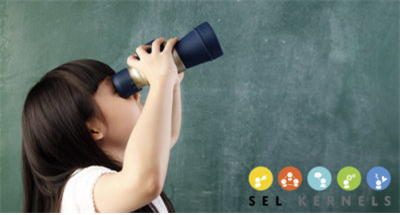
Students use their “Focus Binoculars” to guess what the
teacher or a fellow student is looking at.
학생들은 ‘집중 망원경’을 사용하여
선생님 혹은 친구들이 무엇을 보는지 알아 맞힌다.
Level: PreK/Lower Elementary, Upper Elementary, Middle School
수준: 유치원생 ~ 중학생
Duration: ≤ 15 minutes
지속시간: ≤15분
Topics: Student Well-Being, SEL
Kernels™, SEL for
Students: Self-Awareness and Self-Management, SEL for
Students: Social Awareness and Relationship Skills
주제: 학생들의 안녕,
SEL(사회정서적 배움의
약자) Kernels™, 학생을 위한 SEL: 자기인식과 자기관리, 학생을 위한 SEL: 사회적 인식과 대인관계 능력
Planning For
It 사전 준비
1. Why Do
This? 이 활동을 하는 이유는??
Focus Power helps students to
listen and follow instructions, stay engaged in classroom activities, and
persist even when interrupted or when facing challenges. They also use Focus
Power to pay attention to others and have engaging conversations with peers.
집중력은 학생들에게 교사의 설명을 잘 따르고 반 활동들에 활발하게 참여할 수 있게 하며, 어려움에 직면할 때 포기하지 않고 계속하는
데 도움을 준다.
학생들은 타인에게 관심을 갖고 또래들과 흡입력 있는 대화를 갖는 데에 집중력을 사용할
수 있다.
2. When You
Might Use This Practice 이 활동을 하는 때는?
Integrated into a daily or weekly
schedule as a routine
매일 혹은 주마다 루틴 중 하나로 실시할 수
있다.
During a designated SEL block of
10-15 minutes per day for Kernels practice or as time allows
Kernels 활동을 위해 매일 10-15분으로 지정된 사회–정서 학습 시간을 이용하거나, 시간이 되는 대로 해 볼 수 있다.
During a morning meeting, a
transition, after recess, or at the end of the day
조회, 종례
혹은 쉬는 시간에도 할 수 있다.
Throughout the school year to
create a supportive classroom community
1년 내내 지속하여 서로 지지하는 반 공동체
만들기에 도움이 될 수도 있다.
Time
Required 소요시간
: ≤ 15 minutes (15 분 이내)
Materials 준비물 : None 없음
Learning Objective 학습 목적 :
Students will: Practice focusing and attention
관심 갖기,
집중하기를 실천, 연습할 수 있다.
How To Do It 하는 방법
Reflection Before the
Practice 시작 전에 고려할 사항들
How well do you sustain attention on something or someone,
while ignoring distractions? What strategies and practices help you to maintain
focus and attention (e.g, mindfulness, removing distractions from the room or
setting)?
방해 요소가 있을 때 어떤
물건이나 인물에 대한 집중을 얼마나 잘 유지하는가? 어떤 전략들과 활동들이 집중과 관심을 유지하는 데에 도움이 되는가? (예: 마음챙김, 방이나 환경에서 방해요소를 제거)
Take a few minutes to read the “Focus
Power” practice
before introducing the game.
게임을 소개하기 이전에
잠시 (앞서 번역된) “집중력” 글을 읽어 보는
것이 좋다.
The Big Idea 전체적인 개념
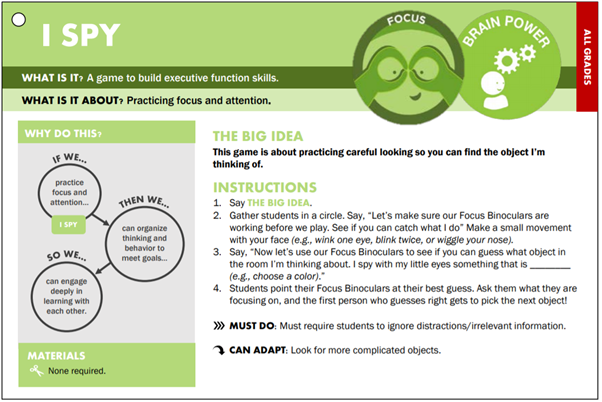
The game is about practicing
careful looking so you can find the object I’m thinking of.
내가 생각하는 사물을 찾을 수 있도록 주위 깊게 살펴보는 연습하는 게임이다.
Instructions 설명
Introduce Focus
Power to
students, if necessary.
필요한 경우 학생들에게 “집중력”이란 개념을 소개해라.
Say the Big Idea (see above).
위에서 언급한 이 활동의 전반적인 개념을 설명해라
Gather students in a circle. Say:
학생들을 동그라미로 모으고(비대면에선 할 필요가 없지만) 말하라:
Let’s make sure our Focus
Binoculars are working before we play. See if you can catch what I
do.
게임을 하기 전에 우리 ‘집중 망원경‘이 제대로 작동하는지 확인하자. 내가 뭘 하는지 볼 수 있는지 확인해보자.
Make a small movement with your
face (e.g., wink one eye, blink twice, or wiggle your nose).
약간의 표정 변화를 줘 보자. (예: 한 쪽 눈으로 윙크를 하든지, 눈을 두 번 깜박이든지, 코를 움직여라).
Say: 그
후에는, 이렇게 말해 보자.
Now let’s use our Focus Binoculars
to see if you can guess what object in the room I’m thinking about. I spy with
my little eyes something that is______ (e.g., choose a color).
자, 이제 너희들이 이 방에 있는 물건 중에 내가 뭘 생각하고 있는지 알아 맞출 수 있는지, ‘집중 망원경‘을 사용해서 확인해보자. 내
눈에는 _________(예: 해당 물건의 색깔)인 무언가가 보인다.
Students point their Focus
Binoculars at their best guess. Ask them what they are focusing on, and the
first person who guesses right gets to pick the next object!
학생들은 자신들이 생각하는 답에 해당하는 물건으로 그들의 ‘집중 망원경‘을 가리킬 것이다. 무엇에 초점을 맞춘 건지 물어보고, 정확하게 알아 맞춘 첫번째 학생에게 다음 사물을 고를 수 있게 한다.
Must do 필수사항
Must require students to ignore
distractions/irrelevant information.
학생들이 방해요소들과 불필요한 정보들을 무시하도록 해야 한다.
Can adapt 수정 가능한 사항들
Look for more complicated objects.
더 복잡하고 어려운 사물들로 실시할 수 있다.
Adaptations 추가 사항들
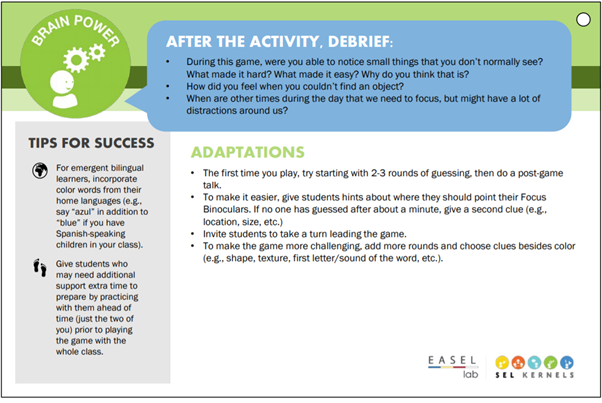
The first time you play, try
starting with 2-3 rounds of guessing, then do a post-game talk.
처음 2~3차례는 알아맞히기 게임을 해 보고, 그 다음에는 토의를 해 볼 수 있다.
To make it easier, give students
hints about where they should point their Focus Binoculars. If no one has
guessed after about a minute, give a second clue (e.g., location, size, etc.).
더 쉽게 하려면, 학생들에게 집중 망원을 어디에다 가리켜야 할 지 힌트를 주고, 일
분 이상 아무도
맞히지 못한다면, 두 번째
힌트를 줘라 (예: 장소, 크기, 등).
Invite students to take a turn
leading the game.
학생들이 번갈아 가면서 게임을 주도할 수 있도록 하라.
To make the game more challenging,
add more rounds and choose clues besides color (e.g., shape, texture, first
letter/sound of the word, etc.).
게임을 더 어렵고 재미있게 만들기 위해서는 여러 라운드에 걸쳐서 게임을 해 보고, 색깔 외에 다른 특징을 골라서 말해라 (예: 모형, 질감, 단어의 첫 글자, 등).
After the activity, debrief 활동 후, 설명
During
this game, were you able to notice small things that you don’t normally see?
What made it hard? What made it easy? Why do you think that is?
이 게임을 하는 동안 평소에 보지 않는 작은 것들을 주목할 수 있었는가? 무엇이 이 놀이를 어렵게 하였는가? 무엇이 이 놀이를 쉽게 하였는가? 왜 그런 것 같은가?
How did
you feel when you couldn’t find an object?
어떤 사물을 찾지 못했을 때 어떤 느낌이 들었는가?
When
are other times during the day that we need to focus, but might have a lot of
distractions around us?
하루 중에 집중을 필요로 하지만 주위에 방해가 많은 다른 때는 언제인가?
For more debriefing questions,
see Brain
Games Practice.
더 많은 활동 후 보고 질문들을 보고 싶다면, Brain
Games Practice를 보라.
Source 출처
This practice is part of the SEL
Kernels project developed by the EASEL Lab at Harvard University.
이 활동은 하버드 대학교의 EASEL Lab에서 개발한 SEL Kernels 프로젝트의 일부이다.
The Research Behind It and Evidence
That It Works
배경 연구와 효과성
Children who are able to
effectively manage their thinking, attention, and behavior are also more likely
to have better
grades and higher standardized test scores.
자신의 생각과 주의 그리고 태도를 효과적으로 관리할 수 있는 아이들이 더 나은 성적과
더 높은 표준 시험 점수를 가질 가능성이 크다.
Why Does It Matter? 중요성
Children use cognitive
regulation skills whenever faced with tasks that require concentration,
planning, problem solving, coordination, conscious choices among alternatives,
or overriding a strong internal or external desire—all key skills for behavioral and academic success.
아이들은 집중력, 계획하는 능력, 문제 해결 능력, 합동하는 능력, 대안 중에 의식적인 선택, 또는 강한 내/외적 욕구를 기각하는 것—모두 행실과 학업적 성공을 위한
주요 능력들—이 요구되는 과업을 대면할 할 때마다 의식적 통제 능력을 사용한다.
These skills enable children to
prioritize and sequence behavior (e.g., put their pants on before their shoes),
inhibit dominant or familiar responses in favor of a more appropriate one
(e.g., raise their hand rather than blurt out the answer), maintain
task-relevant information in mind (e.g., remember the teacher’s request to wash
hands and then put coats on before going outside), resist distractions, switch
between task goals, use information to make decisions, and create abstract
rules and handle novel situations.
이 능력들은 아이들이 행동의 우선순위를 매기고 순서를 정하고 (예: 신발을 신기 전에 바지를 입는 것), 익숙하거나 더 우세한 반응을 더 적절한 반응을 위해 억제하고 (예: 답을 무심결에 말하는 것보다 손을 드는 것), 머릿속에 과업에 관련된 정보를 유지하고 (예: 밖에 나가기 이전에 손을 씻고 외투를 입으라는 선생님의 요청을 기억하는 것), 정신 없게 하는 것들에 저항하고, 과업 목표 사이를 전환하고, 결정을 내리기 위해 정보를 사용하고, 그리고 추상적인 규칙을 창조하고 새로운 상황을 다룰 수 있도록 한다.
https://ggie.berkeley.edu/practice/i-spy-an-sel-kernels-brain-game/
https://ggie.berkeley.edu/wp-content/uploads/2020/02/I_Spy_Brain_Game.pdf